My third article review is The Effects of Computer Graphics Organizers on the Narrative Writing of Elementary School Students with Specific Learning Disabilities. I appreciate the specific nature of this study and found it quite interesting. The paper begins with basic information concerning difficulties with writing (and more specifically the process of writing) for people with specific learning disabilities (SLDs). The authors (Gonzalez-Leto, Barbetta, and Unzueta) were only able to find five prominent studies on this subject and only three of these included students with SLDs. Although all of these studies showed a positive (only based on attitude) or positive (quantitative) outcome of the use of computer based graphic organizers, I found the limited overall number of participants to be concerning. The largest group (24 students) was in the study which only presented data on the attitude of the students toward the writing process. The other two studies had 12 and 4 students, not a significant study group, in my opinion. I hoped that this study would be on a larger group, but only 4 students were included in this study. The study is detailed and appears to follow valid research techniques, including interobserver agreement testing, and uses a number of quantitative measures to determine increase quality of writing, I am also concerned about the limitations section of the study. This section notes that due to the limited typing abilities, the participants hand wrote their compositions instead of typing them while viewing the diagrams created by the computer graphic organizers. This says to me that the computer was not necessarily the reason for the positive outcome. Perhaps the provided outline (The outline appears to have a great deal of information in it,. I cannot determine from this paper which parts of the outline were pre-populated and which were filled out by a participant, but feel the sentence sections were pre-populated.) with its pre-populated questions, even in paper form, might have produced the same positive results.
I understand that this article is a peer-reviewed study. However, I wonder if the extremely limited number of students or the lack of typing ability (which affected the use of the computer, as intended) made the author's question the time and effort put into this study. I know I would have questioned the usefulness of the study.
Gonzalez-Ledo, M., Barbetta, P. b., & Unzueta, C. H. (2015). The Effects of Computer Graphic Organizers on the Narrative Writing of Elementary School Students with Specific Learning Disabilities. Journal of Special Education Technology, 30(1), 29-42.
Monday, May 4, 2015

Saturday, May 2, 2015
Technology Implementation Project
Technology
Implementation Unit Project
Technology
Description
The
technology I will integrate into my lesson is ElectroCity,
found at http://www.electrocity.co.nz/. The website describes ElectroCity as an online game developed
specifically for teachers and students. Students build and manage their own
virtual towns and cities, making decisions about energy generation,
environmental management, supply and demand, budgeting and more.
ElectroCity is free and can be played on any
computer that has Flash 8 or higher installed. From the ElectroCity site, it’s easy for teachers to
set up and manage, teachers register once and students do not need to register
at all. The site follows with, “There's
no
correct way to play and many different approaches can lead to success. This is
not a game of right and wrong, but of pros and cons.”
The
site continues, “Students will
deal with delayed reward versus instant gratification and face many other
classic real-world dilemmas. Two
games
are never the same. The landscape varies each game, random events affect your
progress and there are so many interesting decisions to be made that you'll
always want to try 'just one more time'. To
get
the highest score you have to play the game in a balanced and realistic way.
You need to listen to your citizens, grow your city, maintain a healthy cash
flow and care for the environment.”
If
you're worried about your internet connection in class, you can download a
limited version of the game that runs on any computer and doesn't need internet
access. Note:
Cities built with these offline versions cannot be saved, and will not be added
to the site.
Technology
Implementation Lesson Plan
In groups,
students will decide how to best build and maintain their virtual city, so that
they balance the city’s growth with its environmental impact.
Instructional
Objectives
After
completion of the project, 80% of students will receive a passing score on the
Unit 6 curriculum based assessment on the impact of people on the
ecosystem. Covers Science TEKS 5.9 -
Organisms and environments. The student knows and understands that living
organisms within an ecosystem interact with one another and with their
environment.
Intended
Audience
Fifth
grade Science
Learning
Theories/Instructional Design Model
ADDIE,
Constructivism
Anticipated
Lesson Time
jigsaw strategy study of various
energy sources – 45-60 minutes
whole
group lesson on How to Play game – 30-45 minutes
group
planning – 30-45 minutes
game
play – 2 45 minute lessons
writing/survey
– 30-45 minutes
TOTAL
– 210-285 minutes
Lesson
Details
Jigsaw
strategy
(https://www.jigsaw.org/)
will be used to divide groups into
separate learning groups to study various energy sources (see below), including
environmental impact information. ElectroCity was created in New Zealand, so some of the terminology is different and should
be correlated to US terms. In addition, the game allows for the use of two
types of energy which are not significant US energy sources. Teachers must
determine whether to use these energy sources. Although they are not available
in US, allow their use in this game could increase awareness of these
eco-friendly methods. (Analysis from ADDIE)
includes energy created by heat, including:
Coal (39% of US energy sources 2014*)
Natural gas (27% of US energy sources 2014*)
Geothermal (0.4% of US energy sources 2014*)
Biomass (1.7% of US energy sources 2014*)
Petroleum (1% of US energy sources 2014*)
Other gases
(<1% of US energy sources 2014*)
4.4% of US energy sources 2014*
19% of US energy sources 2014*
6% of US energy sources 2014*
0.4% of US energy sources 2014*
not a significant US energy source 2014*
not a significant US energy source 2014*
Continuing
the
Jigsaw Method, students will return to their group to teach each other about
the energy sources they studied
(constructivist
method of student led learning). When this is complete, the teacher will
present the How To Play portion of ElectroCity
(http://www.electrocity.co.nz/HowToPlay/)
to the class, making sure to define the 4 categories that are scored and
emphasizing a game is complete after 150 turns. Additionally, the students
should understand while it takes 3-6 turns to build many things, multiple
builds can occur at the same time.
Using
this
knowledge, groups will determine how to build their city (using the given 150
turns) and the priority (1-4) their team puts
on each of the 4 categories (security of supply
(avoiding blackouts), popularity (how happy your citizens are), population,
and environmental impact). (Design from
ADDIE)
Once plan
is completed, groups will work together to create
and maintain their city (using Electrocity)
and learn the final grades on the 4 categories
and their overall grade. (Development and integration from ADDIE)
Follow-up
Upon
completion, each student will write a 1 page paper
comparing the priorities set on each category
with the outcome. (Evaluation from ADDIE) A teamwork survey will also be
conducted, to verify all students participated.
Given
more time, an additional design, development, and integration phase would be
completed. Teachers could offer extra credit for an additional game with higher
scores based on knowledge gained.
*The U.S.
Energy
Information Administration. (March 31, 2015).
Retrieved
from http://www.eia.gov/tools/faqs/faq.cfm?id=427&t=3.
Saturday, April 25, 2015
Article Review #2
Article Review
Ely, E.E., Pullen, P.C., Kennedy, M.J., & Cole Williams, M. (2015). A Multimedia Tool to Deliver Professional Development of Vocabulary Instruction. Journal of Special Education Technology, 30(1), 59-72.
This is a very thorough article on research done concerning the effectiveness of a specific multimedia approach to deliver professional development. The authors chose the use of evidence-based vocabulary instruction as their study topic. Details about the general lack of research on effective professional development delivery, failure of many teachers to use evidence-based reading practices, and lack of effective vocabulary instruction in schools is included. Difficulty moving effective practices from research to classroom and the general ineffectiveness of most professional development are also covered.
The authors include information from previous studies concerning ways to bridge the research-to-practice gap. They include information from a study in 2000 that called the current understanding of how to promote sustainable use of evidence-based practices, emerging after 30 years of research. Basic guidelines which have been established over this time period concerning effective PD are given and the authors point out how vague and broad these are. Research on teachers watching video of themselves teaching and then reflecting is discussed as effective, however the limited studies on use of video when other teachers model instruction is also detailed.
This article gives a great amount of information on how the videos were produced, and the theories behind the reasoning. The article also includes the online address of the video, so readers can view it. The video was produced using specific guidelines, from previous research, and these guidelines are also included in the article. Data about the participants, setting, baseline, intervention, and post-intervention are given. Discussion about how and why the data was collected, is also included. The checklist used to collect the data is also included. With all of this information included in the article, the study is quite easy to understand.
The results of the study were positive, and detailed in the article. The authors clearly understood the limitations of their study, including the limited number of participants and discussed them. Future research implications are also discussed.
This article was extremely interesting to me, because of the topic of effective professional development (PD). I lead PD on classroom management and behavior each year for my campus and will be presenting at Region 10 this summer. I have often worried about the effectiveness of my presentations and wondered how to get the teachers in the training to implement the information presented.
The in-depth discussion of research on vocabulary instruction and professional development, were very interesting to me. The authors point out current reform efforts focusing on professional development, a very current and controversial topic. I, personally, have had little professional development I found to be useful or I carried forward into my classroom. The occasional training I did find useful have been high cost, outside of the district training. Any research into how to provide professional development which will effect my classroom quickly and continue long-term is important research to me and to my students.
Saturday, April 4, 2015
Article Review 1
Having a background in software engineering, I have experienced the extreme ratio of men to women in engineering, firsthand. I have also heard the occasional news story addressing single-gender education and the benefits to girls in mathematics. So, when I came across an article titled Female Students' Experiences of Computer Technology in Single- versus Mixed-Gender School Settings, I knew I had to review it.
Burke and Murphy (2006) conducted a small study of female students who had experienced both mixed-gender and single-gender computer use in the classroom. The 12 students who volunteered for this study had all used computers in a mixed-gender setting in junior high and were currently in a grade 12 class on Communications' Technology in a single-gender school. The data collected was via a questionnaire, an interview, and a focus group.
The article cites several previous studies that led to this study. Among these are studies on gender inequality in math, science, and technology, studies on the growth of technology in the workplace, and information on the low percentage of women in computer science. This allows anyone, regardless of their personal experiences, to understand the need for research in this area.
The questions and responses fell into the three areas of attention, confidence, and learning. The researchers concluded the girls felt they received more attention, felt more confident, and indicated they felt they were given more complex tasks, which resulted in more learning. These findings were similar to previous studies involving single-gender education.
One criticism I have concerning this research is the small sample. With a study of only 12 students, and all in the same current single-gender class setting, many things could have led to the feelings expressed by the students. Perhaps the teacher they had currently was simply better at giving attention, building confidence, and teaching than the teachers they had previously. The ratio of students to teachers, computers to students, and available technology could have all been contributing factors to the feelings of the students. Additionally, the general feelings of students in junior high versus students in their senior year of high school are significantly different, in my experience.
The authors do acknowledge the feelings of the students toward their school in general and the size of the school (much smaller than their previous schools) could have changed the general feelings of the participants. They also feel it might be of value to conduct further research between two high schools (one of mixed-gender and one of single-gender) comparing the perceptions of the students toward technology and the actual learning of these students.
Overall, the article was worth reading, but led me to more questions than answers. I hope to find additional studies in this area, with larger study groups and less variables. In my area of interest, special education, I am not certain the discrepancy between the feelings of females toward technology in single-gender and mixed-gender classes would exist. I would love to see a study to confirm this, but in my experience of 50+ special education students, gender discrepancy of any kind has not been a concern. Perhaps the low developmental (and social) level of my students would explain this lack of discrepancy.
Reference:
Burke, L. & Murphy, E. (2006). Female students’ experiences of computer technology in single- versus mixed-gender school settings. E-Journal of Instructional Science and Technology, v9, n1.
Burke and Murphy (2006) conducted a small study of female students who had experienced both mixed-gender and single-gender computer use in the classroom. The 12 students who volunteered for this study had all used computers in a mixed-gender setting in junior high and were currently in a grade 12 class on Communications' Technology in a single-gender school. The data collected was via a questionnaire, an interview, and a focus group.
The article cites several previous studies that led to this study. Among these are studies on gender inequality in math, science, and technology, studies on the growth of technology in the workplace, and information on the low percentage of women in computer science. This allows anyone, regardless of their personal experiences, to understand the need for research in this area.
The questions and responses fell into the three areas of attention, confidence, and learning. The researchers concluded the girls felt they received more attention, felt more confident, and indicated they felt they were given more complex tasks, which resulted in more learning. These findings were similar to previous studies involving single-gender education.
One criticism I have concerning this research is the small sample. With a study of only 12 students, and all in the same current single-gender class setting, many things could have led to the feelings expressed by the students. Perhaps the teacher they had currently was simply better at giving attention, building confidence, and teaching than the teachers they had previously. The ratio of students to teachers, computers to students, and available technology could have all been contributing factors to the feelings of the students. Additionally, the general feelings of students in junior high versus students in their senior year of high school are significantly different, in my experience.
The authors do acknowledge the feelings of the students toward their school in general and the size of the school (much smaller than their previous schools) could have changed the general feelings of the participants. They also feel it might be of value to conduct further research between two high schools (one of mixed-gender and one of single-gender) comparing the perceptions of the students toward technology and the actual learning of these students.
Overall, the article was worth reading, but led me to more questions than answers. I hope to find additional studies in this area, with larger study groups and less variables. In my area of interest, special education, I am not certain the discrepancy between the feelings of females toward technology in single-gender and mixed-gender classes would exist. I would love to see a study to confirm this, but in my experience of 50+ special education students, gender discrepancy of any kind has not been a concern. Perhaps the low developmental (and social) level of my students would explain this lack of discrepancy.
Reference:
Burke, L. & Murphy, E. (2006). Female students’ experiences of computer technology in single- versus mixed-gender school settings. E-Journal of Instructional Science and Technology, v9, n1.
Friday, March 6, 2015
Final Post
Because my name is unique, my vanity search still shows my information. I see some new information, such as my Twitter account, but basically it is still the same information. I do see a slight expansion of my information, but since I used the same blog as a previous class, I still see 95% of the same information. I appreciate that my vanity search includes my information only, and not someone else's. I find this to be a lucky break of a unique name.
I have learned about a great number of web 2.0 tools that will be valuable to my future endeavors. I still struggle with the value added from Twitter, but have really enjoyed learning about Protopage. Protopage has given me the ability to organize a large number of web links into one visual page. I feel this is the most valuable web 2.0 tool that I discovered.
There are many other tools I enjoyed learning about this semester that will contribute to my classroom. These include NearPod and ShowMe. These tools allow my students to create activities from their learning and me to share learning with them in a controlled environment. In general I am glad I have explored these tools and feel they will serve me and my students a great deal.
There are many other tools I enjoyed learning about this semester that will contribute to my classroom. These include NearPod and ShowMe. These tools allow my students to create activities from their learning and me to share learning with them in a controlled environment. In general I am glad I have explored these tools and feel they will serve me and my students a great deal.
Sunday, March 1, 2015
Sunday, February 22, 2015
Adventures in Social Bookmarking
This week's adventure has been easier than some of the others. I like the idea of being able to access bookmarks on the many computers that I use each week. I have previously sent site addresses from myself via email, which takes a lot more effort than diigo does. In addition, these sites are saved for me with additional information (my notes and tags), which I love. I would love to introduce diigo to other ALE teachers in my district and begin a group with them! Excited about this tool!
Sunday, February 15, 2015
Aggregated Website Journey
Although I had a difficult time getting any of the apps to work as feeds, it seems that Netvibes may have more capabilities than Protopage. However, without searching for videos or learning from someone who is a user of Netvibes, it is easy to reach a level of frustration that leaves you wanting to try the next option. Protopage was a completely different experience. It was easy to use without seeking additional help. I was able to easily add everything that I wanted to and look forward to using it in my classroom. I have already envisioned having a tab for each of my students (I only have 11) with various links to websites and media they use. I loved how it brought all of the information from this course into one, easily accessible format. Before putting everything into Protopage, each of the tools I wanted to explore, links for this class, twitter, the tools I had reviewed, and my blog were all open in various tabs. This is a much more efficient and usable way to contain all of that information. I really, really like this tool!
Sunday, February 8, 2015
Continued Twitter Adventure, YouTube Adventure, and Group Project
Continued Twitter Adventure
As this Twitter Adventure continued, I consulted the person (in my house) most likely to use Twitter regularly, my 13 year old son. I talked to him about my struggles with the tool - that it seemed to be very output only. For example, someone from our class mentioned the use of a tool to communicate with students and I asked how other districts were responding to the use of these tools (mine has not been very positive about it). I got no response. Tools that I have used (before now) have more back and forth, so I struggle with this. My son said he follows people/groups who have something to say that might interest him. For example, the Dallas Mavericks and a person who posts YouTube videos he tends to enjoy. I think it is possible I haven't appreciated Twitter because I was basing it on other tools. I will continue to explore Twitter and use it in this way. So far, however, I have not appreciated the tweets of the "friends of friends" type situation. For example, I followed WFAA (local news) and have gotten several tweets from other people who WFAA follows. I am not a fan of this, and would love to know if you can turn it off.
YouTube Adventure
I have used YouTube in my classroom for various videos and at home (I removed and installed my alternator with a YouTube video). However, I had not played with the channels or playlists section. Side note: I am a huge fan of Pinterest. I love the fact that you can search for ideas for any facet of your life and find great ideas. YouTube is like Pinterest squared! I can spend hours on Pinterest, but I could spend days on YouTube. I was a little frustrated by my inability to find videos about my specific type of classroom, but it is such a specific type of setting. I will continue to look for these videos, but then again, maybe I will just make my own. :)
Group Project
I will say, honestly, that I have never enjoyed group projects. I tended to be the one to do most of the work and, even worse, be the 'nag' of the group in an effort to make progress. However, this was so much worse. I never had a problem contacting my group members before - they had to come to class. This was not the case. I know (at least last week) the 2 MIA members were at least still enrolled, but that is basically all I know. The third member doesn't respond quickly to emails and is more of a procrastinator than I am. I am still not certain that he has added his reviews to mine. So, I am sure there is a lesson in this, but group work is not my cup of tea.
As this Twitter Adventure continued, I consulted the person (in my house) most likely to use Twitter regularly, my 13 year old son. I talked to him about my struggles with the tool - that it seemed to be very output only. For example, someone from our class mentioned the use of a tool to communicate with students and I asked how other districts were responding to the use of these tools (mine has not been very positive about it). I got no response. Tools that I have used (before now) have more back and forth, so I struggle with this. My son said he follows people/groups who have something to say that might interest him. For example, the Dallas Mavericks and a person who posts YouTube videos he tends to enjoy. I think it is possible I haven't appreciated Twitter because I was basing it on other tools. I will continue to explore Twitter and use it in this way. So far, however, I have not appreciated the tweets of the "friends of friends" type situation. For example, I followed WFAA (local news) and have gotten several tweets from other people who WFAA follows. I am not a fan of this, and would love to know if you can turn it off.
YouTube Adventure
I have used YouTube in my classroom for various videos and at home (I removed and installed my alternator with a YouTube video). However, I had not played with the channels or playlists section. Side note: I am a huge fan of Pinterest. I love the fact that you can search for ideas for any facet of your life and find great ideas. YouTube is like Pinterest squared! I can spend hours on Pinterest, but I could spend days on YouTube. I was a little frustrated by my inability to find videos about my specific type of classroom, but it is such a specific type of setting. I will continue to look for these videos, but then again, maybe I will just make my own. :)
Group Project
I will say, honestly, that I have never enjoyed group projects. I tended to be the one to do most of the work and, even worse, be the 'nag' of the group in an effort to make progress. However, this was so much worse. I never had a problem contacting my group members before - they had to come to class. This was not the case. I know (at least last week) the 2 MIA members were at least still enrolled, but that is basically all I know. The third member doesn't respond quickly to emails and is more of a procrastinator than I am. I am still not certain that he has added his reviews to mine. So, I am sure there is a lesson in this, but group work is not my cup of tea.
Saturday, February 7, 2015
Review of ShowMe
I recently started using a tool with my students and have truly enjoyed the outcomes. When I was tasked to review some technology tools, I knew this is one I wanted to explore further and review. The tool is called ShowMe and has allowed my students who struggle to understand the concepts in comprehension questions to show me (no pun was intended) they understood and appreciated the book. My review, using the tool, is here and, even better, one of my student's retelling of the book No, David is included here as well. I hope you can find a way to use this great tool in your classroom.
My Review
My Student's Retelling
My Review
My Student's Retelling
Sunday, February 1, 2015
My Twitter Adventure
Oh, what an adventure it has been. I have felt lost, found, confused, abandoned, and ignorant. I have managed to utterly disgust my 13 year old son several times. He almost never looks at me that way. I already knew that I had to stop referring to "The Twitter", but apparently telling him I was unable to find the "Twitter tweets" of my class was even worse. I am not a person who is uncomfortable with technology. I can write code in a variety of languages. However, some of these tools have come into our world and seeing no use for them, I have let them pass me by. Twitter is one. So, I am still not sure that I have mastered Twitter, but I do no better than to say "hash tag" out loud.
I see how twitter could be useful to me as a learner and as an educator. Allowing people to discuss the current training or class without having to verbally express themselves, is clearly useful. In my old mind, it is a little like the old "passing notes" in class or the current texting during class. Perhaps, not as harsh toward the instructor, but we could all use more practice in questioning without offending or critiquing without hurting another person. To me, Twitter could allow that. I am not sure that every teacher/instructor would like to know how their students feel about their instruction, but I think most of us would love to know when our students do not understand. One of the big trends on Teachers Pay Teachers right now is exit tickets. Basically a quick question for students to answer on the way out, often accompanied by an opinion on their confidence level with the topic. Could Twitter not provide at least part of this? Even a simple questions and comments request by the teacher at the end of class might allow those who need additional guidance to ask for it - before the test.
As a teacher of students who do not read and who do not have cell phones, I do not see this as a tool I could use in my current setting. However, in the future, I would like to be in a position to help other special education teachers and I feel Twitter could be a real value to me.
Thank you for making me take the plunge into "The Twitter".
I see how twitter could be useful to me as a learner and as an educator. Allowing people to discuss the current training or class without having to verbally express themselves, is clearly useful. In my old mind, it is a little like the old "passing notes" in class or the current texting during class. Perhaps, not as harsh toward the instructor, but we could all use more practice in questioning without offending or critiquing without hurting another person. To me, Twitter could allow that. I am not sure that every teacher/instructor would like to know how their students feel about their instruction, but I think most of us would love to know when our students do not understand. One of the big trends on Teachers Pay Teachers right now is exit tickets. Basically a quick question for students to answer on the way out, often accompanied by an opinion on their confidence level with the topic. Could Twitter not provide at least part of this? Even a simple questions and comments request by the teacher at the end of class might allow those who need additional guidance to ask for it - before the test.
As a teacher of students who do not read and who do not have cell phones, I do not see this as a tool I could use in my current setting. However, in the future, I would like to be in a position to help other special education teachers and I feel Twitter could be a real value to me.
Thank you for making me take the plunge into "The Twitter".
Sunday, January 25, 2015
Vanity Search 2015
I have heard of people searching themselves online, but never thought to do it myself. I consider myself one of the best at what I do, in the area that I do it, but have never considered myself worth searching. When I searched myself, I found pretty much what I expected - a few blogs made for college. I see this as a combination of my past and present...an engineer who shouldn't be in headlines and a teacher who wishes to spread her thoughts and ideas, but doesn't really know how. I predict, five years from now, that my search will be amazingly different.
Friday, October 10, 2014
New Directions in IDT
I feel that e-learning environments have a future in special
education. While the use may not be
broadly used, I think it could make a huge difference in the lives of some of
our most fragile learners. The current
method used to educate children with medical issues so severe that attending
school would endanger them is frequent visits from a home-bound teacher. The amount of time spent with the teacher does
not come close to the hours that other children spend. Additionally, these children are often very
isolated and miss out on the socialization that school offers. There have a few trials (and hopefully
accompanying research will be out soon) of students attending school using
e-learning via a stand in robot with the child’s live feed as the face. According
to the ABC
News report, the parents seem to be much happier with this arrangement
compared to the home-bound teacher method.
Rich media, when used correctly, will add a great deal to
the education of students with special needs.
Whether the visual is needed because the student is unable to
successfully read the text or because the specific disability shows visual
processing as a strength (autism, for example).
Usually, line drawings are the best for children in my classroom,
especially when they are created piece by piece while the child watches.
I feel that virtual worlds will have a significant place in
special education, especially for social learning. For example, learning to communicate in a
typical, socially accepted way requires a lot of practice, with many
partners. Virtual worlds can allow
students to watch social interactions and hopefully in the future to interact
with a virtual person to practice social interactions (think sim with Siri-type
design).
It may take time for specific design for people with special needs, but could be a great benefit to the population. I look forward to what the future brings!
Sunday, October 5, 2014
IDT Positions
I am currently a special education teacher for elementary children with low-incidence special needs. I am enrolled in the masters program for Educational Technology and this is my first semester. I wanted to pursue my masters because I need to have one to move into a position where I can help more children with low-incidence disabilities. I chose this program after accidentally stumbling upon it when looking into the educational leadership program and realizing that this program is an amazing combination of my previous (software engineer) and current (special education teacher) positions. Upon graduation, I would like to eventually become a district level helping teacher for the program that I work in.
As a district level helping teacher, I would like to use the knowledge I gain about Instructional Design and Technology in three ways. One is to evaluate and analyse the programs that are developed for the children that we serve. I feel that sometimes higher level administration pay too much attention to the presentations that they are given and not enough attention to the actual program. The second way I would like to use my knowledge to design and develop content materials for the students. I know that the students in my classroom benefit greatly from my materials and I would like to expand that to the district level. Last, I would like to use my knowledge to achieve better communication between special education teachers. Each classroom operates as an individual entity, even though we are all attempting to do the same job. While most grade level teachers meet weekly with their grade level, we rarely meet. When special ed teachers do meet, it is not to share ideas, but to listen to administration. I would like to change this using my educational technology knowledge.
There are several organizations mentioned in the book that I think would be beneficial to my future career and continued learning. A few of those are Association for the Advancement of Computing in Education and Association for Educational Communications and Technology. I absolutely think that joining these organizations prior to graduating would benefit me. Not only would it be show my desire to continue learning about my profession, but it would also give me additional reading and information that would help me show my level of knowledge about the field.
As a district level helping teacher, I would like to use the knowledge I gain about Instructional Design and Technology in three ways. One is to evaluate and analyse the programs that are developed for the children that we serve. I feel that sometimes higher level administration pay too much attention to the presentations that they are given and not enough attention to the actual program. The second way I would like to use my knowledge to design and develop content materials for the students. I know that the students in my classroom benefit greatly from my materials and I would like to expand that to the district level. Last, I would like to use my knowledge to achieve better communication between special education teachers. Each classroom operates as an individual entity, even though we are all attempting to do the same job. While most grade level teachers meet weekly with their grade level, we rarely meet. When special ed teachers do meet, it is not to share ideas, but to listen to administration. I would like to change this using my educational technology knowledge.
There are several organizations mentioned in the book that I think would be beneficial to my future career and continued learning. A few of those are Association for the Advancement of Computing in Education and Association for Educational Communications and Technology. I absolutely think that joining these organizations prior to graduating would benefit me. Not only would it be show my desire to continue learning about my profession, but it would also give me additional reading and information that would help me show my level of knowledge about the field.
Sunday, September 28, 2014
Trend and Issues in Various Settings
There are many differences and similarities in Instructional Design across various settings. Business and industry, military and P-12 education all share the difficulties of funding. Although businesses do not have the constraints of government funding, demands of consumers to reduce pricing and demands of stock-holders to increase profits place businesses in the same type of financial distress. I do however feel that businesses have more ability to supply money when needed. Both military and P-12 education depend on government funding. As I have seen as both a military contracted software engineer and as a teacher, government funding can lead to extreme financial fluctuation. In the military, changes in political parties can cause financial fluctuation. In education, law changes can be the cause. Several years ago, the additional funding from No Child Left Behind allowed a short-term time of financing for schools, especially special education departments. This led to a large number of first generation iPads to be purchased for special education classrooms in my district. These iPads were distributed with very little instruction or guidance. They have also become older technology. Many newer apps are not compatible with these units and the QR code technologies that are becoming more popular are not usable with these units, due to no camera on the units. The large influx of funds provided some new, exciting technology, but how much did this technology contribute to the education of special education students? Has anyone done studies to see how or if these are being used? Will we replace them with the next influx of funding even without a study?
I worry a great deal about the youth of today and how they will address the problems already occurring due to over-population and under planning. The current education system, curriculum and instructional practices might one day show an increase in problem solving, but even if that occurs, will children care to address the problems in nature? The paper, pencil and textbook learning which may take away any magic of the natural world.
I love some of the things that I read about teaching in Japan. Teachers are highly revered and competition to become a teacher is fierce. Teachers have self taught or passed from on to another the skills of technology because they want what is best for their students. In a country where teachers are not highly-paid and less revered over time (generations ago, parents would never have treated teachers the way that they do now), our country's teachers are often too discouraged to learn new skills on their own. Additionally, the pool of applicants for many teaching jobs is low to medium quality, due to changes necessary (alternative certification, waivers, exemptions) to simply have enough teachers to fill seats. Can you imagine living in a country where you had to work hard and compete to have the honor of becoming a teacher? The non-competitive, non-outcome based pay structure here in the United States is another problem. Can you imagine being paid more for going above and beyond? Can you imagine having to do what is best for students because there are many others waiting to take your place who will?
I would like to comment on some of the European countries reluctance to accept technology and instructional design. In general, I dislike the "that is the way we have always done it" mentality. I think being open-minded to change is important. However, I worry that in the United States we have over embraced the concept of technology, not as a tool for better teaching but simply as a tool. Many technologies are being purchased and handed out at schools across the US, but the training necessary (beyond the 'this is how to turn it on' training) to inspire teachers to utilize the technology to increase learning and independence is not occurring. All the STaR charts in the world are not going to create change if there is no inspiration to want to change.
I worry a great deal about the youth of today and how they will address the problems already occurring due to over-population and under planning. The current education system, curriculum and instructional practices might one day show an increase in problem solving, but even if that occurs, will children care to address the problems in nature? The paper, pencil and textbook learning which may take away any magic of the natural world.
I love some of the things that I read about teaching in Japan. Teachers are highly revered and competition to become a teacher is fierce. Teachers have self taught or passed from on to another the skills of technology because they want what is best for their students. In a country where teachers are not highly-paid and less revered over time (generations ago, parents would never have treated teachers the way that they do now), our country's teachers are often too discouraged to learn new skills on their own. Additionally, the pool of applicants for many teaching jobs is low to medium quality, due to changes necessary (alternative certification, waivers, exemptions) to simply have enough teachers to fill seats. Can you imagine living in a country where you had to work hard and compete to have the honor of becoming a teacher? The non-competitive, non-outcome based pay structure here in the United States is another problem. Can you imagine being paid more for going above and beyond? Can you imagine having to do what is best for students because there are many others waiting to take your place who will?
I would like to comment on some of the European countries reluctance to accept technology and instructional design. In general, I dislike the "that is the way we have always done it" mentality. I think being open-minded to change is important. However, I worry that in the United States we have over embraced the concept of technology, not as a tool for better teaching but simply as a tool. Many technologies are being purchased and handed out at schools across the US, but the training necessary (beyond the 'this is how to turn it on' training) to inspire teachers to utilize the technology to increase learning and independence is not occurring. All the STaR charts in the world are not going to create change if there is no inspiration to want to change.
Sunday, September 21, 2014
Human Performance Technology (week 4 reading response)
For the past several years, I have been discouraged by the quality of teachers who teach children with low-incidence special needs. This is not based on data or objective measurement, but is purely subjective. However, even years ago, when I spent large amounts of time in these classrooms during observation and student teaching, I collected a long list of "things I will not do" and very few things on the list of things I would do. I remember the coach who said he "wanted to keep coaching, but didn't really want the stress of teaching," so he got his special education certification. (Thanks, Texas for making it possible for any teacher, currently certified in anything to just pass any other test and gain certification.) Even now, when I visit other classrooms like mine and, more often, listen to the concerns of others who spend a great deal of time in these classrooms (therapists and itinerant personnel), I worry about the education that children with the most serious special needs are receiving.
Standardize testing was supposed to help verify that 'no child is left behind', but here in Texas, in my opinion, the results of the testing is more a reflection of the efforts of the teacher than the student. Is this actually standardized testing? Also, is it providing any information about the quality of the teaching that is occurring in that classroom? The standardized testing that occurs in general education settings makes the assumption that basically all classrooms in a given school (and sadly across districts and states) are generally equal. How can this be assumed in my type of classroom, when each child is in the program because of serious differences. I do not think this testing is giving us the measurable data that we need.
So, how do we improve the quality of teachers in low-incidence special education classrooms? My first solution, seems fairly simple to me. I believe that my district needs a better worker selection process and better a better evaluation process for these teachers. Currently, the Special Education Department interviews and hires Diagnosticians, Speech Language Pathologists, Occupational and Physical Therapists and many other specialists that are considered "itinerant". These professionals are assigned to one or several schools and serve the population of students that need them within these schools. Because these professionals are not "teachers" they do not have Professional Development and Standards (PDAS) evaluations (more on this later). Teachers are interviewed and hired by campus administration. The Special Education Department dictates their curriculum, produces their handbook of expectations, holds their professional development meetings, and can move these teachers from one campus to another. Then, they are evaluated, using the PDAS evaluation system, by the campus administration. I have tried to simplify this in the table below.
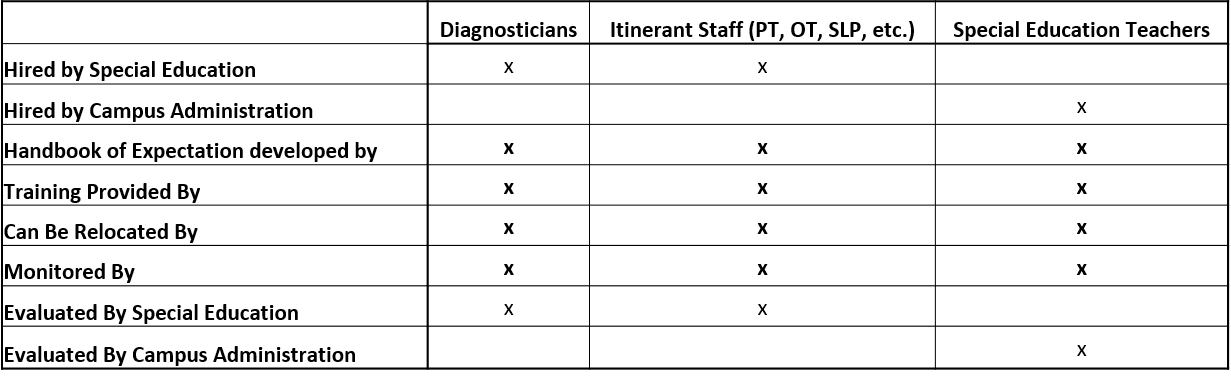
What does this mean? Special education teachers are under the control of the Special Education Department. However, the department, in reality, has no control over them. In order to influence their evaluation, at all, they would have to communicate with, and convince, the campus administration. The Special Education Department does not evaluate the teachers under their guidance and more importantly can not put one of these teachers on an improvement plan. Why is this important? Special education classrooms, especially those that are self-contained and contain mostly students with low-incidence disabilities, are rare. For example, my classroom has 11 students, who, if they attended the school closest to them (instead of the school closest to them with my type of classroom) they would be spread across 5 different schools. This means that 4 schools in my surrounding area do not have a classroom like mine. So, the chances of a person becoming an administrator without having any exposure to this type of classroom are high. So, how do these administrators know what a great self-contained classroom should look like? How do they know what questions to ask a person interviewing for this position? I understand the need for teachers to be evaluated using the PDAS evaluation system, and I believe that this is why principals hire and evaluate special education teachers. I also know that in order to be a coordinator for special education in my district, you must have principal certification. So, my non-instructional solution is that all candidates for a special education position (especially the self-contained positions) must be, at a minimum, interviewed and approved by the Special Education Department. My preference would be for these teachers to be interviewed and hired by the Special Education Department. In addition, I think that, still using the PDAS evaluation system, these teachers be evaluated by the Special Education Department. The administration in the Special Education Department visit (hopefully) all of these classrooms over the year and know the specifics of what these classrooms should look like. They can compare apples to apples, while campus administrators are comparing apples to oranges. Would this make my PDAS evaluation more difficult? Yes. However, as a teacher who is frustrated by the quality of education that children with severe special needs are receiving, I would welcome it.
Performance support systems are systems that provide access to support information at the time of need. Performance support is best used when tasks are not frequent and critical in nature. My first thought was that performance support could not be used to help in the problem that I am currently addressing: the lack of quality teachers who teach children with low-incidence special needs. I then realized that I was thinking of teacher performance when I tried to apply performance support. However, the teacher's is not the only performance that occurs here. It is possible that campus administration is failing to hire quality teachers for these positions. Could we use performance support to help with this? Absolutely! I, personally, consider hiring quality special education teachers as very critical, but even if the district, considering all the other teaching positions, consider it less critical, these situation are low frequency. Whether performance support could be a stand-alone method to help campus administrators make better hiring decisions or training needs to be added, there is definitely an application here. How could performance support be applied? Perhaps, in addition to the standard set of questions to ask perspective teachers, the Special Education Department should provide a more specialized set of questions for these teachers. Also, the Special Education Department should take the standard "walk-through" expectations and PDAS expectations and define what that should look like in this specialized classroom. Additionally, as a training addition, campus administrators could be given a list of quality self-contained special education classrooms that they could visit.
**Quick note to reader - I am sorry that this post is so long, but I am very passionate about this subject and found some great motivation in the reading today. I feel like I should add a link to cute kittens or something here, so I did one better and am adding a link to an amazing song a brother wrote about his little sister, who happens to have Down Syndrome. If you really need a break, go listen to this kid's lyrics. If only everyone felt that way.
**Question to self - Is there a limit to the length of posts?
Knowledge management in my particular type of classroom is a definite problem. Even campuses that have my type of classroom typically only have one. This means that collaboration is difficult. The monthly meetings that we used to have were held after school, so participation was limited due to exhaustion and the desire to go home. We now have monthly, on-line meetings where we watch and listen to our coordinator and can type if we have questions, which isn't conducive to collaboration. The 'products' that we produce (student success) are difficult to compare or present. While the tacit knowledge that we have could be so valuable to increase the quality of teaching, we have not found a way to manage it. I use the term "reinvent the wheel" when talking about our classrooms, because we often have common students, situations, curriculum, goals and objectives, but we are each dealing with them separately. Rarely do teachers in my type of classroom ask one another how they dealt with something. I tend to be one of the few that offers suggestions at meetings and feel that it falls on deaf ears. Occasionally, a teacher will present something they learned at a training, but again, with limited success. I am, honestly, at a loss how to collect the tacit knowledge of strong, long-time special education teachers much less how to manage it. I tried, at the start of this year, to place activities on the intranet that I had created for my students, so that other teachers could use them, but have not received any feedback to know whether they are using them. The reading this week made me realize that I am simply adding to the stuff being thrown at the teachers. The informal learning experiences that lead to this tacit knowledge is extensive in our classrooms. There is not a lot of guidance (even on Google) to show a new teacher how to schedule when you have 10 students in grades 1-5 and each grade goes to specials (PE and such) at different times, each grade teaches various subjects at different times and some of your students go out for reading and some for science, plus everyone needs lunch, including your paraprofessionals and you. Every year, once I gather the information from the other teachers, it takes me hours to pencil out a schedule. Has it gotten easier each year? Yes. Could I make a quick video about how I make a schedule? Absolutely. I think this is the way that I should be working to share my informal learning experiences.
The section on informal learning really inspired me. While I have been trying various techniques to help with improve the quality of teaching in special education, I have forgotten the most important part of learning, the teachers have to want to learn. I do not need to start with materials or invitations to visit my classroom. I need to start with something that makes these teachers want to learn more. I have to lure them in as the museums have. I am not sure that my knowledge and passion can be codified and managed, but maybe I could use what I have learned and my reasoning for learning to help others replicate it. At this point, I have already contacted a parent of one of my students to help me with my plan to do just this. I would like to create a video detailing how my classroom is structured and specifics of what students and staff do each day, but with added (inspirational, if you will) information. Things like, how I quit my software engineering job to become a special education teacher, how my son (who doesn't talk or walk at 11) inspires me and how rewarding our jobs can be. The parent that I asked to do the video with me has a child in my classroom. This is her third year in my class and 3 years ago at her transition ARD (exiting the Preschool Program for Children with Disabilities (PPCD)), I talked this mom into giving me a chance. She and her husband had decided that they were going to place their daughter in a private school. I did not want to see this family spend the money to send their child to this school, when I knew that I could do an amazing job with their daughter. The mom saw my passion and decided to give me a chance and is thrilled with the education that her daughter is receiving. That is so rewarding to me. So, this mom is going to talk about this experience and maybe together we can inspire. I am not unrealistic in thinking that every teacher will watch the video. But, I have learned here that the way that I am going to start a true informal learning program to benefit these children is to inspire them to want to learn.
As I said, I was really inspired by this reading and looking forward to trying to change the problem, one teacher at a time. Thanks for reading my long post. I hope you found some inspiration as well!
Standardize testing was supposed to help verify that 'no child is left behind', but here in Texas, in my opinion, the results of the testing is more a reflection of the efforts of the teacher than the student. Is this actually standardized testing? Also, is it providing any information about the quality of the teaching that is occurring in that classroom? The standardized testing that occurs in general education settings makes the assumption that basically all classrooms in a given school (and sadly across districts and states) are generally equal. How can this be assumed in my type of classroom, when each child is in the program because of serious differences. I do not think this testing is giving us the measurable data that we need.
So, how do we improve the quality of teachers in low-incidence special education classrooms? My first solution, seems fairly simple to me. I believe that my district needs a better worker selection process and better a better evaluation process for these teachers. Currently, the Special Education Department interviews and hires Diagnosticians, Speech Language Pathologists, Occupational and Physical Therapists and many other specialists that are considered "itinerant". These professionals are assigned to one or several schools and serve the population of students that need them within these schools. Because these professionals are not "teachers" they do not have Professional Development and Standards (PDAS) evaluations (more on this later). Teachers are interviewed and hired by campus administration. The Special Education Department dictates their curriculum, produces their handbook of expectations, holds their professional development meetings, and can move these teachers from one campus to another. Then, they are evaluated, using the PDAS evaluation system, by the campus administration. I have tried to simplify this in the table below.
What does this mean? Special education teachers are under the control of the Special Education Department. However, the department, in reality, has no control over them. In order to influence their evaluation, at all, they would have to communicate with, and convince, the campus administration. The Special Education Department does not evaluate the teachers under their guidance and more importantly can not put one of these teachers on an improvement plan. Why is this important? Special education classrooms, especially those that are self-contained and contain mostly students with low-incidence disabilities, are rare. For example, my classroom has 11 students, who, if they attended the school closest to them (instead of the school closest to them with my type of classroom) they would be spread across 5 different schools. This means that 4 schools in my surrounding area do not have a classroom like mine. So, the chances of a person becoming an administrator without having any exposure to this type of classroom are high. So, how do these administrators know what a great self-contained classroom should look like? How do they know what questions to ask a person interviewing for this position? I understand the need for teachers to be evaluated using the PDAS evaluation system, and I believe that this is why principals hire and evaluate special education teachers. I also know that in order to be a coordinator for special education in my district, you must have principal certification. So, my non-instructional solution is that all candidates for a special education position (especially the self-contained positions) must be, at a minimum, interviewed and approved by the Special Education Department. My preference would be for these teachers to be interviewed and hired by the Special Education Department. In addition, I think that, still using the PDAS evaluation system, these teachers be evaluated by the Special Education Department. The administration in the Special Education Department visit (hopefully) all of these classrooms over the year and know the specifics of what these classrooms should look like. They can compare apples to apples, while campus administrators are comparing apples to oranges. Would this make my PDAS evaluation more difficult? Yes. However, as a teacher who is frustrated by the quality of education that children with severe special needs are receiving, I would welcome it.
Performance support systems are systems that provide access to support information at the time of need. Performance support is best used when tasks are not frequent and critical in nature. My first thought was that performance support could not be used to help in the problem that I am currently addressing: the lack of quality teachers who teach children with low-incidence special needs. I then realized that I was thinking of teacher performance when I tried to apply performance support. However, the teacher's is not the only performance that occurs here. It is possible that campus administration is failing to hire quality teachers for these positions. Could we use performance support to help with this? Absolutely! I, personally, consider hiring quality special education teachers as very critical, but even if the district, considering all the other teaching positions, consider it less critical, these situation are low frequency. Whether performance support could be a stand-alone method to help campus administrators make better hiring decisions or training needs to be added, there is definitely an application here. How could performance support be applied? Perhaps, in addition to the standard set of questions to ask perspective teachers, the Special Education Department should provide a more specialized set of questions for these teachers. Also, the Special Education Department should take the standard "walk-through" expectations and PDAS expectations and define what that should look like in this specialized classroom. Additionally, as a training addition, campus administrators could be given a list of quality self-contained special education classrooms that they could visit.
**Quick note to reader - I am sorry that this post is so long, but I am very passionate about this subject and found some great motivation in the reading today. I feel like I should add a link to cute kittens or something here, so I did one better and am adding a link to an amazing song a brother wrote about his little sister, who happens to have Down Syndrome. If you really need a break, go listen to this kid's lyrics. If only everyone felt that way.
**Question to self - Is there a limit to the length of posts?
Knowledge management in my particular type of classroom is a definite problem. Even campuses that have my type of classroom typically only have one. This means that collaboration is difficult. The monthly meetings that we used to have were held after school, so participation was limited due to exhaustion and the desire to go home. We now have monthly, on-line meetings where we watch and listen to our coordinator and can type if we have questions, which isn't conducive to collaboration. The 'products' that we produce (student success) are difficult to compare or present. While the tacit knowledge that we have could be so valuable to increase the quality of teaching, we have not found a way to manage it. I use the term "reinvent the wheel" when talking about our classrooms, because we often have common students, situations, curriculum, goals and objectives, but we are each dealing with them separately. Rarely do teachers in my type of classroom ask one another how they dealt with something. I tend to be one of the few that offers suggestions at meetings and feel that it falls on deaf ears. Occasionally, a teacher will present something they learned at a training, but again, with limited success. I am, honestly, at a loss how to collect the tacit knowledge of strong, long-time special education teachers much less how to manage it. I tried, at the start of this year, to place activities on the intranet that I had created for my students, so that other teachers could use them, but have not received any feedback to know whether they are using them. The reading this week made me realize that I am simply adding to the stuff being thrown at the teachers. The informal learning experiences that lead to this tacit knowledge is extensive in our classrooms. There is not a lot of guidance (even on Google) to show a new teacher how to schedule when you have 10 students in grades 1-5 and each grade goes to specials (PE and such) at different times, each grade teaches various subjects at different times and some of your students go out for reading and some for science, plus everyone needs lunch, including your paraprofessionals and you. Every year, once I gather the information from the other teachers, it takes me hours to pencil out a schedule. Has it gotten easier each year? Yes. Could I make a quick video about how I make a schedule? Absolutely. I think this is the way that I should be working to share my informal learning experiences.
The section on informal learning really inspired me. While I have been trying various techniques to help with improve the quality of teaching in special education, I have forgotten the most important part of learning, the teachers have to want to learn. I do not need to start with materials or invitations to visit my classroom. I need to start with something that makes these teachers want to learn more. I have to lure them in as the museums have. I am not sure that my knowledge and passion can be codified and managed, but maybe I could use what I have learned and my reasoning for learning to help others replicate it. At this point, I have already contacted a parent of one of my students to help me with my plan to do just this. I would like to create a video detailing how my classroom is structured and specifics of what students and staff do each day, but with added (inspirational, if you will) information. Things like, how I quit my software engineering job to become a special education teacher, how my son (who doesn't talk or walk at 11) inspires me and how rewarding our jobs can be. The parent that I asked to do the video with me has a child in my classroom. This is her third year in my class and 3 years ago at her transition ARD (exiting the Preschool Program for Children with Disabilities (PPCD)), I talked this mom into giving me a chance. She and her husband had decided that they were going to place their daughter in a private school. I did not want to see this family spend the money to send their child to this school, when I knew that I could do an amazing job with their daughter. The mom saw my passion and decided to give me a chance and is thrilled with the education that her daughter is receiving. That is so rewarding to me. So, this mom is going to talk about this experience and maybe together we can inspire. I am not unrealistic in thinking that every teacher will watch the video. But, I have learned here that the way that I am going to start a true informal learning program to benefit these children is to inspire them to want to learn.
As I said, I was really inspired by this reading and looking forward to trying to change the problem, one teacher at a time. Thanks for reading my long post. I hope you found some inspiration as well!
Sunday, September 14, 2014
Evaluating, Implementing and Managing Instructional Programs and Projects
The two chosen evaluation models of the text focuses on are CIPP and Kirkpatrick models for evaluation. The text also mentions Patton's utilization focused evaluation (UFE). According to betterevaluation.org, UFE is based on the principle that evaluation should be judged on its usefulness to its intended user. The two essential elements are that the primary users of the evaluation must be clearly identified and personally engaged from the beginning of the evaluation. Second, evaluation by the primary intended users guide all other decisions made. Basically, UFE is focused on real and specific users and uses. I feel that this would be a very useful method of evaluation for students in a resource or content mastery type special education setting. After identifying the student, explain the new ARD objectives to them in their own terms and gain their commitment and focus the evaluation (objective). Decide on evaluation options (project, test, etc.) that will determine whether the student has mastered the objective. Teach, test and then analyze the finding and reach conclusions. Let the student and ARD committee know what the conclusions are. I utilize the basic framework discussed here, but my students are not usually able to understand the evaluation process and feel ownership of it. So, in reality although my framework is similar, my methods are not utilization focused evaluation.
Another model for evaluation mentioned in the text is Chen's theory evaluation. In summary, according to the American Journal of Evaluation 32(2), activities are actions, outputs are immediate results and outcomes are multi-leveled. Initial outcomes are changes in knowledge, skills and abilities, intermediate outcomes are changes in behavior and long-term outcomes are long-term changes brought about by intermediate outcomes. Chen's theory seems to focus not just on the outcome, but on the how and why of the outcome, so that it could lead to better evaluation questions, better programs and better information for replication. I think that this evaluation model is especially useful when working with students who have autism. When I design a lesson for a student with autism, whether it works or doesn't I need to evaluate why is did or didn't work. What part of the lesson made it successful or unsuccessful? Was it the theme, the method, the media, the person? Why did it work? How didn't it work?
If I were to develop a series of professional development sessions focusing on technology use in the classroom for teachers, I would first better utilize my underused resources. Do I have a teacher or teachers who are particularly good at using technology in the classroom? Can I build them into a stronger core team? Can I use this core team to train and support teachers who are struggling to utilize current resources? Are we under using a technology that we currently have? Can we spend a small amount to bring someone in to train the teacher on this technology instead of adding a new technology? Or better yet, can I send one of my teachers who is good with this technology to a training that could strengthen their skills with the technology and have that teacher train the others? Basically, in a time of economic decline, how can we get the most out of the resources that we have?
Sunday, September 7, 2014
Theories and Models of Learning and Instruction
Epistemology, the study of what and how we come to know, is made up of different instructional methods and theories. If we take learning out of the human world, what do we find? Why does a bird fly? Is it because another bird was eaten from the nest when it didn't fly? Is it because it was born in a nest and can't get out otherwise? Is it because it has flown short periods successfully and wants to add to that? I understand that epistemology is the study of what and how humans come to know, but also question whether epistemology includes all people. I have worked with and loved people who are considered a few generations ago to be "uneducable". Even today, they are considered to be unable to learn. However, I have seen learning occur for these students. This is why I struggle with some of the more complex learning theories. I do, however, think that a researcher who chose to study people who others dismissed would define learning in a different way. Behavior theory focuses on positive and negative reinforcement. Cognitive Information Theory concedes to environment. Schema theory focuses on organizing information in ways that related in predictable ways. Situated learning focused on relies on social and cultural determinates. These are all theories of learning. Gagne chose to focus less on learning and more on instruction. He chose to include the various styles of learning into his definition of teaching: cognitive, affective and psychomotor. His definition did a better job including all people. Gagne defined categories of learning and events of instruction, which includes various levels of learning, and I feel includes even the lowest levels of learning.
Side note, as a learner, I embrace all instructional theories to some degree. I was the teacher's pet learner who constantly got comments on my self-motivation. It is only as a mom and teacher that I struggle with the definitions and theories. I have never taught a learner who was self-motivated. Generally speaking, my students do not care about grades. Honestly, neither do their parents. The parents of my students are concerned with forward motion. Basically, how can their learning help them in their future. I am not judging here. I am concerned with this as well. As a learner, I am a relativist. I believe that knowledge is mostly based on my frame of reference. I know that I learn better when the information is relative to my learning. I once did a report on Turkey. The one thing that I remember is that they are a mostly Christian country. Why do I remember this? That is the one fact that I related to. It is only as a teacher that I am a positivist. As a teacher, I apply behaviorist principles. I believe that positive and negative reinforcement change learning completely. Without the principles of behaviorism, I would struggle to add education to my classroom. My positive reinforcements create an environment where learning occurs. These beliefs are a constant conflict within me. I was not a learner who required reinforcement. The most common description of me as a learner was "self-motivated". The general description of my students does not include the description of self-motivated.
I worry about the differences in behaviorist and constructivist perspectives. I understand that the general principles of teaching is to teach the future of our society to think for themselves. This is a real concern as a society. I also worry that the general principles of teaching leaves behind an amazing group of people. These people do not likely study the of teaching, but deserve to be a part of the research that is occurring in learning and education. I also recognize that as a teacher of people who are amazing learners when provided with the proper motivation, I truly believe in motivation. While higher-level learners might be self-motivated, few people with specific disabilities are self-motivated. As a teacher of people with disabilities, I believe in motivating my students. Without motivation being presented to my students, I do not think they would learn. So, everyday I work to motivate my students to learn, in an effort to earn rewards (that I have set up specific to that student). This is how I have become a very effective teacher of students who have struggled under other teachers.
Side note, as a learner, I embrace all instructional theories to some degree. I was the teacher's pet learner who constantly got comments on my self-motivation. It is only as a mom and teacher that I struggle with the definitions and theories. I have never taught a learner who was self-motivated. Generally speaking, my students do not care about grades. Honestly, neither do their parents. The parents of my students are concerned with forward motion. Basically, how can their learning help them in their future. I am not judging here. I am concerned with this as well. As a learner, I am a relativist. I believe that knowledge is mostly based on my frame of reference. I know that I learn better when the information is relative to my learning. I once did a report on Turkey. The one thing that I remember is that they are a mostly Christian country. Why do I remember this? That is the one fact that I related to. It is only as a teacher that I am a positivist. As a teacher, I apply behaviorist principles. I believe that positive and negative reinforcement change learning completely. Without the principles of behaviorism, I would struggle to add education to my classroom. My positive reinforcements create an environment where learning occurs. These beliefs are a constant conflict within me. I was not a learner who required reinforcement. The most common description of me as a learner was "self-motivated". The general description of my students does not include the description of self-motivated.
I worry about the differences in behaviorist and constructivist perspectives. I understand that the general principles of teaching is to teach the future of our society to think for themselves. This is a real concern as a society. I also worry that the general principles of teaching leaves behind an amazing group of people. These people do not likely study the of teaching, but deserve to be a part of the research that is occurring in learning and education. I also recognize that as a teacher of people who are amazing learners when provided with the proper motivation, I truly believe in motivation. While higher-level learners might be self-motivated, few people with specific disabilities are self-motivated. As a teacher of people with disabilities, I believe in motivating my students. Without motivation being presented to my students, I do not think they would learn. So, everyday I work to motivate my students to learn, in an effort to earn rewards (that I have set up specific to that student). This is how I have become a very effective teacher of students who have struggled under other teachers.
Sunday, August 31, 2014
Defining the IDT Field
In my Introduction to Educational Technology class I defined
educational technology as “integration of ever
advancing technologies and education”.
I recognized that this was a simplistic definition, but reading the
definitions presented over the years by professionals and professional
organizations of the field has made me realize that it was not my definition
that was simple, but my assumption (yes I know what that word means) that
others would define technology and education the same as I do.
My original undergraduate work and first career
was Computer Programming. So when I
think of technology, I think of what goes into the creation of technology –
requirements, design, creation, testing, product release and finally product
use. Additionally, each of these steps
has numerous reviews at each level. When
I use a product, I am, honestly, judging it with a programmer’s knowledge. For example, the “new, improved” method of
signing in each morning at my school is on a computer instead of the old, pen
and paper method. Many mornings I
complain, “Why don’t they just automatically populate that field?” I am sure other teachers ignore me, as they
have learned to, but it makes me insane.
There are two fields, both drop-downs, one for your name (populated by
all teachers’ names at the school) and one for your reason. The drop-down reason field is populate by ONE
item “check-in”.
So, while I found
the AECT, 2008, definition of educational technology to be extreme in its
length, I do see the need for defining each keyword.
I also think that I define education a little
different than most teachers that I work with.
Again, this is based on my background.
For me, as a special education teacher, I need to know what a student
knows, what they need to know, what previous methods to learn it have failed,
their motivators, their sensory needs and what previous methods have to learn
other things have worked. This, for me,
is just a start. I know and have
observed teachers who seem to think that knowing what they are expected to teach
and “teaching” it, usually via lecture method, is the definition of
education.
I still feel that “integration of ever advancing
technologies and education” is a pretty good definition for educational technology. However, I know now that I would need to add
pages of key word definitions to make sure everyone is on the same page. AECT Definition and Terminology Committee of
2008, please forgive any judgment on my part about the lengthiness of your
definition. You clearly had the right
idea.
I would like to take a second to say that I wrote
the above before I read chapter 2.
As a former Software Engineer who is now a special education teacher in
my ninth year, I often say, “I used to be smart.” To say that I multi-task is an extreme
understatement and my brain has suffered because of it. There are days when, after teaching 11
students with a minimum of 15 different objectives each, I cannot identify the
place where dishes go as a ‘cabinet’. I
use this example because it is real. So,
when I read things in chapter 2 that closely followed what I had written as my
first response, I ran in and made my husband listen to me explain that maybe I
am still fairly intelligent (in a completely incomprehensible, excited, book
waving way that took 20 minutes). So, I had
to take a moment to pat myself on the back.
As I stated above, being a special education teacher
with students who have disabilities that usually result in them being 3 or more
grade levels behind means that I see teaching a little different. In order to be effective, I must be student
centered. If I attempt to teach all
students with the exact same materials or in the same way, I will fail. To start with, all of my students are on
different levels. I need to define goals
for each student that takes into account what they know, what they need to know
and how long it should take them to get there.
My job, by definition is goal oriented. A committee of people set goals and
objectives for each student, at least once a year. I must provide data that shows progress on these
goals 6 times a year.
I work very hard to suggest goals that will lead to
eventual meaningful performance.
For example, I never write an objective for a student to count by two. As an adult, I cannot find a true, meaningful
performance for that objective. I skip
counting by two and go straight to counting by five. We count by 5 when we tell time on an analog
clock. The method I teach to count
change (hairy money) uses counting by fives to determine the value. These are objectives that will add
meaningful, functional value to their future.
Since I began teaching, writing objectives that are
measurable has become a big focus. Gone
(hopefully) are the days when a student comes in with objectives that make you
wonder what the teacher was talking about.
Objectives and goals have a time line (within 36 weeks), a clear goal
(with count to 20 by 1s), a method (by verbalizing), a measure (with 70%
accuracy or with 14 of 20 numbers correct) and any supports given (with a
visual number line). This has helped to
bring us closer to the concepts of measuring outcomes in a reliable and
valid way.
I love that the terms ‘what the learner knows’ and ‘what
they need to know’ appears in chapter 2.
I run my classroom knowing those are the most important pieces of
information I can have. I build new
materials based on this information, present the materials to the student,
analyze the outcome, modify my ‘what the learner knows’ (for better or worse)
and build new materials based on this information. This is a cycle I spend most of my time
in. Only behavior control and assessment
take up more classroom time and nothing takes up more working at home
time. Again, because of my position in
special ed., data collection is constant.
I know, basically each week, where each child stands on each
objective. This assess, build, assess, and
build method makes my design for each child’s objective is empirical,
iterative and, although I never quite thought of it this way, self-correcting.
I try to make my teaching as much of a team
effort as it can be. I am certainly
involved, as is the student and para-professionals who work in my
classroom. I try to involve the parents,
therapists, and general education teachers as much as possible.
I have always been proud of the quality of education
that I provide my students and love that it lines up so nicely with these
characteristics of instructional design.
I think my background and my ‘engineering mind’ probably caused me to
teach this way and it has worked well for me.
This makes me feel a little better about the limited ‘cuteness’ in my
classroom. J
I think that it is easy for most people to
distinguish instructional media from instructional design. In theory this is a physical device vs. a
process. An iPad can be placed into a
student’s hand. This is instructional
media. However, without instructional
design, what is the student going to learn?
I do think that chalkboards, whiteboards, tables, task cards, textbooks
and many other things are instructional media.
I am less sure where I would place teachers. I suppose I am a media, but I am also an
instructional designer. I feel that the
purpose of instructional design is to teach using data, knowledge and media so
that the student can learn.
Wednesday, August 27, 2014
Introduction
My original love is software engineering...creating an intricate puzzle over time and then trying to solve it, is an amazing adventure. My incredible, doting husband is my second love. Luckily, my first love led me to my second. Then our fourth son was born with a brain difference. Seven years into engineering, I quit and went back to school to pursue a degree in special education. I believe that I have done an exceptional job teaching children with various disabilities and wish that I could do it forever. However, carrying a child of 55 pounds, who does not hold on, has destroyed my spine and after spine surgery, I have looked to positions outside the classroom that will allow me to make the most difference in children with low-incidence disabilities. When I am no longer able to teach in my classroom, this master's degree will help me obtain a position to help other teachers who teach the type of class I currently teach. Who knew I could combine my love of computers and my love of education? I am SO excited to be in my first class in this amazing degree! Oh, goodness, social skills never were easy for me. My name is Christi Abramsky. My students call me "Mrs. A" and most of my co-workers simply call me, "A". I am thrilled to be here learning with you and look forward to this semester!
Christi Abramsky
Christi Abramsky
Subscribe to:
Posts (Atom)